


How to Verify Locksmith Credentials

If you are locked out, dealing with a broken door lock, or replacing keys after a move, it is easy to call the first company that answers. That is exactly when knowing how to verify locksmith credentials matters most. A locksmith works on the doors, keys, vehicles, and access points that protect your home, business, and daily routine, so legitimacy should come before speed.
In California, this is not just about preference. It is a consumer protection issue. A locksmith may have access to your property, your locks, your keys, and in some cases your vehicle information. Hiring someone without checking credentials can lead to poor workmanship, inflated charges, damage to hardware, or a service provider who should not be operating at all.
Why credential checks matter before the job starts
Most customers do not hire a locksmith often. They call when something urgent happens - a tenant moves out, a key breaks in the lock, a storefront door will not secure properly, or a car key stops working. In those moments, people tend to focus on arrival time and price. Both matter, but neither tells you whether the person showing up is qualified and legally operating.
A verified locksmith brings more than tools. They bring accountability. If the company is properly licensed, identifies itself clearly, and gives you a real estimate before work begins, you are dealing with a business that understands professional standards. That does not guarantee perfection, but it greatly reduces your risk.
How to verify locksmith credentials in California
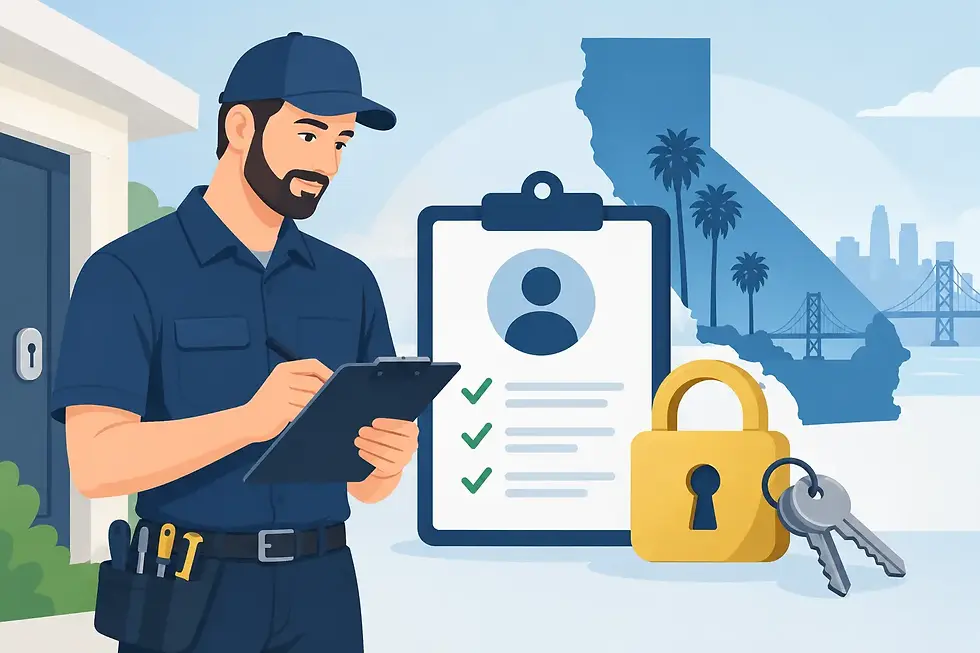
The first step is to confirm state licensing if your state requires it. In California, locksmiths are regulated through the Bureau of Security and Investigative Services, often referred to as BSIS. A legitimate locksmith should be able to provide a license number when asked. If a company avoids that question, changes the subject, or tells you licensing does not matter, treat that as a warning sign.
Once you have the number, verify it through the state licensing system. Make sure the license is active and matches the business name you were given. This step matters because some operators advertise locally without being properly registered, while others use business names that do not line up with any valid license at all.
You should also check whether the company name on the invoice, estimate, and vehicle is consistent. Small local businesses may have simple branding, but the basics should still match. If the technician arrives in an unmarked vehicle, cannot show business identification, and gives you a different company name than the one you called, pause the job until you get clarity.
What a legitimate locksmith should be willing to show you
A professional locksmith should not act annoyed when you ask for credentials. For a reputable company, this is a normal part of the job. At minimum, they should be willing to provide their business name, license information when applicable, and identification when arriving on site.
For larger jobs, such as commercial lock replacement, rekeying for a multi-unit property, or vehicle key programming, it is also reasonable to ask whether they are insured. Insurance does not replace skill, but it does show that the business is operating responsibly. If property damage happens during a repair or installation, insurance becomes more than a checkbox.
Estimates are another form of credential in practice. A trustworthy locksmith will usually give you a realistic service range over the phone based on the information you provide, then explain any changes once they inspect the lock, key, or hardware in person. If the price jumps sharply with no clear reason, that is not professionalism.
Review the business, not just the ad
A polished ad does not prove much. Neither does a top placement in search results. To verify locksmith credentials in a practical way, look at the business behind the phone number. Check whether the company has a real local presence, whether service descriptions are specific, and whether customer feedback mentions the kind of work you need.
A homeowner needing rekey service should look for reviews that mention rekeying, lock changes, or door hardware repair. A property manager should pay attention to feedback about reliability, scheduling, and invoice clarity. A driver who needs a replacement key or remote should look for comments about successful programming and whether the quoted price matched the final bill.
Reviews are not perfect. Every local service business can have an occasional complaint. What matters is the pattern. Repeated mentions of bait-and-switch pricing, unexplained damage, no receipt, or technicians arriving with no clear company identification should carry weight.
Red flags that deserve a hard stop
Some warning signs are subtle, while others are obvious. If the company refuses to provide a license number, that is reason enough to keep looking. The same goes for a technician who arrives and immediately drills a lock without discussing less destructive options first. In many common lockout situations, drilling is not the first or best step.
Be careful with extremely low advertised prices. A service call that sounds far below normal market rates may be designed to get someone to your location, only for the final cost to rise dramatically. Honest locksmith work has real labor, vehicle, equipment, and parts costs behind it. A fair estimate is more believable than a suspiciously cheap one.
Another red flag is pressure. If a locksmith tries to rush you into approving extra hardware, replacing parts without explaining why, or paying cash without documentation, step back. Professional service should feel direct and clear, not confusing.
Questions worth asking before you book
You do not need to turn a service call into an interview, but a few direct questions can tell you a lot. Ask for the business name and license number. Ask whether the technician will arrive with company identification. Ask for an estimated price range and whether there may be added charges for labor, parts, after-hours work, or programming.
If you have a specific need, ask whether they handle that exact type of work regularly. Residential rekeying, commercial hardware replacement, and automotive key programming are not all the same. Some locksmiths specialize narrowly, while others cover a broader range. The right fit depends on the job.
That is especially true for car keys and remotes. A company may offer automotive locksmith services, but not every provider has the equipment or experience to duplicate or replace every make and model. Asking up front can save time and prevent a second service call.
Why local verification matters
For customers in Folsom and the Sacramento area, local presence matters because it adds another layer of accountability. A local locksmith depends on reputation in nearby neighborhoods, not just one-time calls. That usually shows up in clearer communication, better follow-through, and more consistent service.
It also makes verification easier. You can compare the business name, service area, phone number, and licensing information with less guesswork. A company that openly emphasizes verified licensing and straightforward service standards is giving you something useful before the technician even arrives.
OutLock Locksmith is one example of the kind of local provider that makes legitimacy visible rather than treating it like a hidden detail. That approach matters because most customers are not locksmith experts. They just want to know the person working on their locks or keys is qualified, identifiable, and accountable.
Credential checks are not about distrust
Some people hesitate to ask for proof because they do not want to seem rude. In reality, asking how to verify locksmith credentials is part of being a careful customer. A professional should respect that. Locksmith work involves security, access, and trust. Verification is not personal. It is standard due diligence.
And there is a practical side to this. Good locksmiths benefit when customers ask smart questions, because it separates licensed local businesses from operators who rely on confusion. When you verify before work starts, you are more likely to get accurate pricing, better workmanship, and a service experience that feels straightforward from beginning to end.
When you need a locksmith, take an extra minute before saying yes. Ask who they are, confirm they are licensed if required, make sure the business details match, and get the estimate in clear terms. A real professional will not mind. They will expect it.

Comments